What is it?
Technical irrigation management is based on the calculation of irrigation dosage and frequency based on the monitoring of climatic parameters, which involves adjusting irrigation according to weather conditions to optimise water use and improve efficiency in agriculture. At the same time, it requires control of the water content in the soil to ensure that the plant has sufficient moisture conditions for its development.
How is it calculated?
Through standard models such as the Penman-Monteith method for the calculation of evapotranspiration (soil evaporation and plant transpiration) and the soil water balance (Input - Output) we can calculate the irrigation water required by the crop. For this we need to monitor the following climatic variables:
- Daily solar radiation (MJ/m² and day)
- Daily maximum and minimum temperature (ºC)
- Daily maximum and minimum relative humidity (%)
- Average daily wind speed (m/s)
- Rainwater (mm=L/m²)
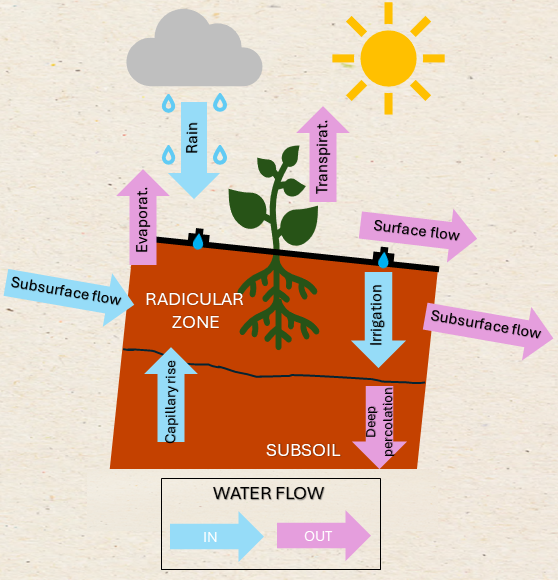
Diagram of water flows in the Soil-Plant-Atmosphere system
Why use this method?
Accuracy and representativeness
The method takes into account multiple climatic variables, such as temperature, relative humidity, wind speed, solar radiation and the water balance in the root zone, which makes it more representative of the actual environmental conditions and the specific water needs of the crop.
Adaptability to different environments
Unlike some simpler methods, this methodology can be adapted to a variety of climatic and geographical conditions. It can be used in a wide range of environments, from hot, dry climates to more humid climates.
International approval
The Penman-Monteith method has been adopted and recommended by international organisations, such as the FAO (Food and Agriculture Organisation of the United Nations), for estimating reference evapotranspiration. This has led to its widespread acceptance in the scientific and agricultural community.
Source: https://www.fao.org/3/x0490e/x0490e06.htm
How can we implement it in our farms?
In order to use this irrigation calculation system we need to perform two actions on the farm.
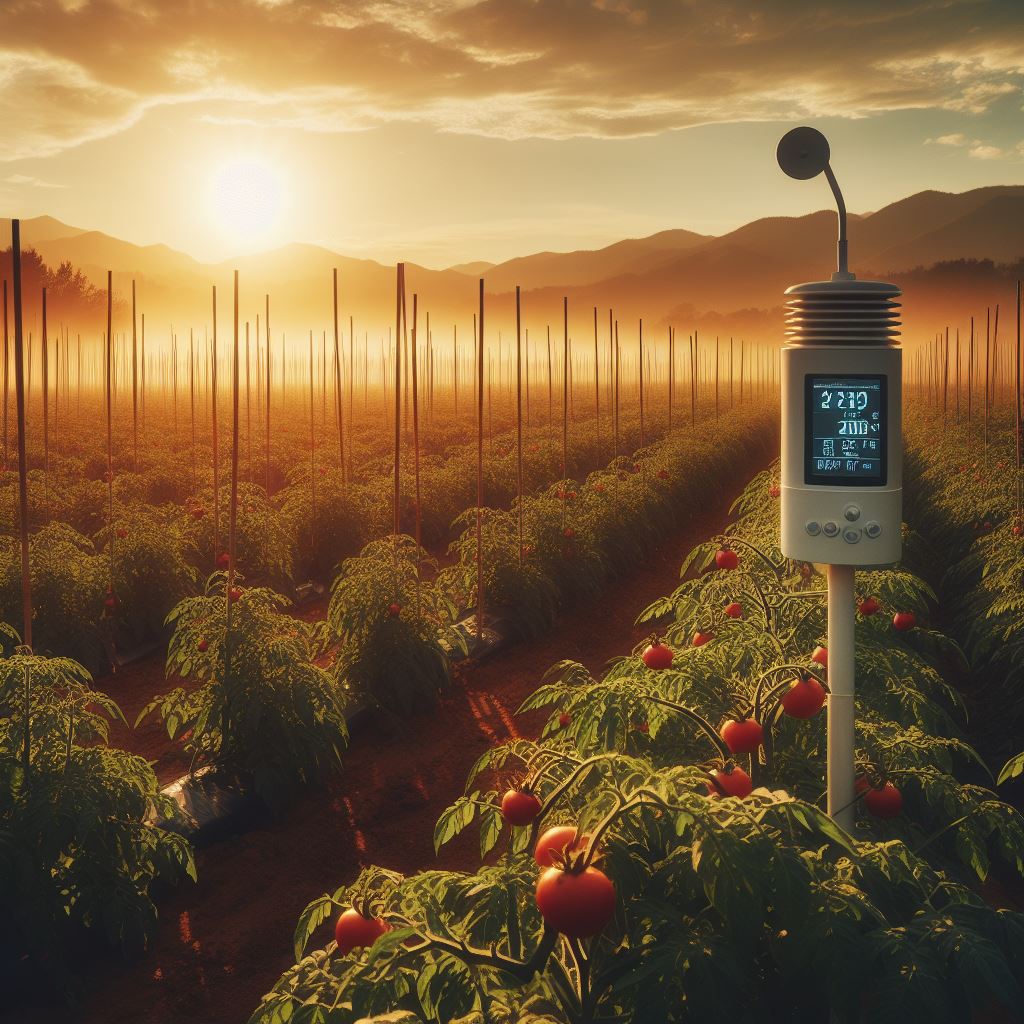
- Monitor climatic variables: install probes or measuring instruments that allow us to take the climatic data referred to (meteorological sensors).
- Control the water content in the soil: by means of tools that allow us to know the volumetric or matrix water content as a means of control.